
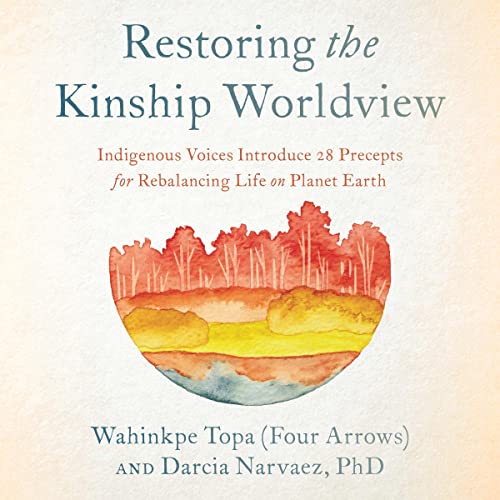
Overview Restoring the Kinship Worldview is a compelling anthology that presents 28 precepts rooted in Indigenous wisdom, aiming to guide humanity towards a more balanced and interconnected existence. Edited by Wahinkpe Topa (Four Arrows) and Darcia Narvaez, the book compiles insights from various Indigenous leaders, including Mourning Dove, Robin Wall Kimmerer, Winona LaDuke, and Xiuhtezcatl Martinez. Each precept is accompanied by reflections and analyses from the editors, offering readers a profound exploration of Indigenous worldviews.
Core Themes Kinship and Interconnectedness: Central to the book is the concept of kinship, emphasizing the deep connections among all living beings and the environment. This perspective encourages a sense of responsibility and care for the natural world.
Contrasting Worldviews: The book juxtaposes Indigenous worldviews with dominant Western paradigms, highlighting differences in governance, spirituality, and relationships with nature. For instance, it contrasts egalitarian rule with hierarchical governance and fearless trust in the universe with fear-based cultures.
Ceremony and Spirituality: The role of ceremony is underscored as vital for maintaining balance and harmony within communities and with the Earth.
Generosity and Collective Well-being: The precepts advocate for prioritizing the greater good over individual gain, fostering communities built on generosity and mutual support.
Nature's Laws as Guiding Principles: Emphasizing the importance of aligning human behavior with the laws of nature, the book suggests that sustainable living arises from respecting and understanding natural systems.
Structure and Content Each chapter begins with a passage from an Indigenous leader, followed by dialogues between the editors that delve into the meaning and implications of the precept. This format creates an engaging narrative that blends storytelling with scholarly analysis, making complex concepts accessible to a broad audience.
Reception The book has been praised for its timely and necessary insights. Tyson Yunkaporta, author of Sand Talk, describes it as "a perfect place to start—the foundation is good relations, making kin both human and nonhuman." Similarly, cultural anthropologist Hillary S. Webb refers to it as "a glorious prism of voices calling out to us to imagine a more inclusive and sustainable way of being" .
However, some readers have noted that the book's format, which includes reflective dialogues and a non-linear structure, may require readers to adjust their expectations from traditional academic texts .
Ideal Audience This book is particularly suited for:
Individuals interested in Indigenous philosophies and worldviews.
Environmentalists seeking alternative perspectives on sustainability.
Educators and students exploring cross-cultural approaches to ecology and ethics.
Readers looking to deepen their understanding of interconnectedness and community-based living.
Further Reading For those interested in exploring similar themes, consider the following works:
Sand Talk: How Indigenous Thinking Can Save the World by Tyson Yunkaporta
Braiding Sweetgrass: Indigenous Wisdom, Scientific Knowledge, and the Teachings of Plants by Robin Wall Kimmerer
The Web of Meaning: Integrating Science and Traditional Wisdom to Find Our Place in the Universe by Jeremy Lent
