
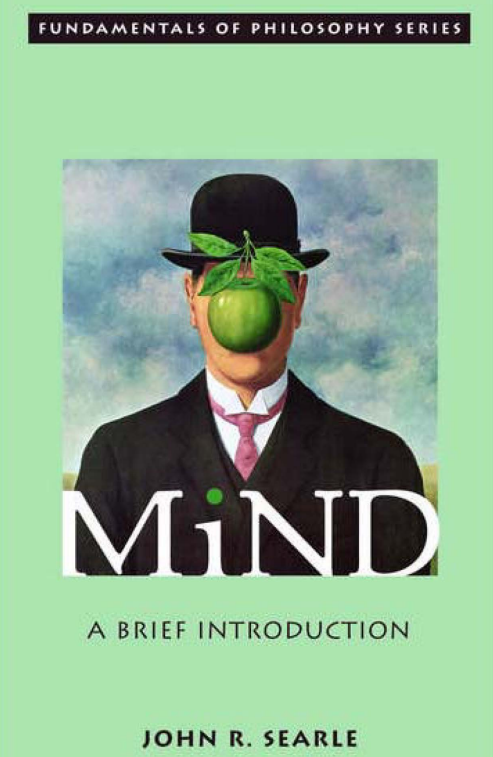
- Overview 1.1. Purpose and Scope Introduction to the Philosophy of Mind: Searle’s book serves as a concise yet comprehensive introduction to the fundamental questions in the philosophy of mind. It addresses issues such as the nature of consciousness, the mind–body problem, intentionality, and the limits of computational models of mind.
Bridging Philosophy and Cognitive Science: The text is written for a broad audience, including students and general readers, and aims to connect philosophical inquiry with the insights of contemporary cognitive science and neuroscience.
Accessible yet Rigorous: While Searle’s style is accessible, he does not shy away from complex discussions, offering readers a clear overview of major debates and his own positions on central issues.
1.2. Central Thesis Biological Naturalism: Searle argues that the mind is both a product of biological processes in the brain and a source of subjective experience that cannot be fully captured by purely physical descriptions.
Consciousness as a Biological Phenomenon: He maintains that while mental states are caused by neurobiological processes, they also have irreducible qualitative aspects (or “qualia”) that define our conscious experience.
Critique of Reductionism and Strong AI: Searle challenges reductionist accounts and computational theories of mind (such as strong AI), arguing that such approaches fail to capture the intrinsic, subjective quality of mental life.
- Key Themes and Arguments 2.1. The Mind–Body Problem Dualism vs. Physicalism: Searle explores the historical debate between dualist perspectives (which posit a fundamental separation between mind and body) and physicalist perspectives (which seek to reduce mental phenomena to physical processes).
Searle’s Position: He defends a form of physicalism, specifically biological naturalism, asserting that while mental states are realized in the brain, they have properties that are not easily reduced to neural events.
Implications for Understanding Consciousness: This stance allows Searle to account for both the causal role of the brain and the irreducible subjective quality of consciousness.
2.2. Consciousness and Subjectivity First-Person Perspective: A major focus is the nature of conscious experience. Searle emphasizes that consciousness is inherently subjective—a “first-person” phenomenon that resists complete third-person, objective analysis.
Qualia and the “What It’s Like” Aspect: He discusses the concept of qualia, the qualitative aspects of experience (e.g., what it feels like to see red or to taste chocolate). These aspects, Searle argues, are central to understanding the mind but cannot be captured by purely physical explanations.
Neural Correlates: Although consciousness is subjective, Searle acknowledges the importance of identifying its neural correlates, thereby bridging subjective experience with objective scientific inquiry.
2.3. Intentionality: The Directedness of Mental States Defining Intentionality: Searle explains that intentionality is the quality of mental states that allows them to be “about” something – that is, to represent or refer to objects, events, or states of affairs in the world.
Relationship to Language and Thought: This concept is explored in relation to how we form beliefs, desires, and thoughts that have specific content, which is crucial for understanding communication and cognition.
Critique of Symbolic Representations: He critiques overly reductionist views that attempt to equate mental intentionality solely with symbolic manipulation, arguing that this misses the lived reality of mental content.
2.4. Critique of Computational Theories and Strong AI The Limitations of the Computer Model: Searle examines the claim that the brain functions like a computer and that consciousness can be replicated by computer programs.
Biological Naturalism vs. Syntax: In his influential discussion (related to his famous Chinese Room argument), Searle argues that while computers manipulate symbols (syntax), they do not understand meaning (semantics).
Implications for Artificial Intelligence: This argument underlines his skepticism towards strong AI—the notion that machines can genuinely have minds—and stresses that understanding the brain’s biological processes is key to understanding consciousness.
2.5. The Evolutionary Perspective on Mind Mind as an Adaptive Feature: Searle also discusses how mental capacities, including consciousness and intentionality, may have evolved as adaptive traits.
Integration with Neuroscience: By linking philosophical inquiry with findings in neuroscience and evolutionary biology, he demonstrates that mental phenomena, while deeply subjective, are firmly rooted in the physical and evolutionary history of the brain.
- Structure of the Book 3.1. Introduction Setting the Stage: The introduction outlines the main questions of the philosophy of mind and sets up the contrast between traditional dualism, physicalism, and Searle’s biological naturalism.
3.2. Development of Key Concepts Chapters on Consciousness: Several chapters are dedicated to exploring the nature of conscious experience, the problem of qualia, and the subjective character of the mind.
Discussion of Intentionality: Dedicated sections examine how mental states are directed at objects and how this property of intentionality distinguishes human thought from mere mechanistic processes.
Critique of AI and Computational Models: A significant portion of the book challenges computational theories of mind, critically analyzing arguments for the feasibility of artificial consciousness.
3.3. Integration of Science and Philosophy Neuroscientific Insights: Searle includes discussions on neural correlates of consciousness and how scientific findings support a physicalist yet non-reductive account of the mind.
Evolutionary Considerations: The final chapters tie in evolutionary perspectives, suggesting that mental capacities are adaptations shaped by natural selection, which adds depth to the discussion of why consciousness exists.
3.4. Conclusion Summary of Findings: The book concludes by synthesizing its key arguments, reaffirming the idea that while the mind is entirely dependent on the brain, its subjective qualities cannot be fully reduced to neural processes.
Implications for Future Research: Searle outlines potential directions for future interdisciplinary research in the philosophy of mind, cognitive science, and neuroscience.
- Significance and Impact 4.1. Contributions to the Philosophy of Mind Clarifying the Mind-Body Relationship: Searle’s work has been influential in clarifying that while mental states are realized in the brain, they have emergent properties that require a nuanced explanation beyond simple reductionism.
Influence on AI Debates: His critiques of computational theories have shaped ongoing debates about the possibilities and limitations of artificial intelligence.
Integration of Subjective and Objective: Searle’s emphasis on bridging the gap between first-person subjective experience and third-person scientific inquiry remains a central concern in contemporary philosophy of mind.
4.2. Broader Academic and Practical Relevance Interdisciplinary Dialogue: The book has fostered dialogue between philosophers, neuroscientists, cognitive scientists, and computer scientists, contributing to a more integrated understanding of consciousness.
Implications for AI and Ethics: Its insights continue to influence discussions on the ethical implications of AI, particularly concerning issues of understanding, consciousness, and machine autonomy.
Educational Value: As an accessible yet thorough introduction, the book remains a standard text in courses on philosophy of mind and cognitive science.
Conclusion The Construction of Social Reality by John R. Searle, although not the book in question, is distinct from Mind: A Brief Introduction—this summary is solely for Mind: A Brief Introduction. In Mind: A Brief Introduction, Searle invites us to reconsider the nature of consciousness by proposing a biological naturalism that acknowledges the physical basis of mental states while upholding the irreducibility of subjective experience. The book is a bridge between philosophical inquiry and scientific investigation, offering a rich framework for understanding one of humanity’s most profound mysteries: the nature of the mind.
Complete Reference Searle, J. R. (2012). Mind: A Brief Introduction (2nd ed.). Oxford, England: Oxford University Press.
