
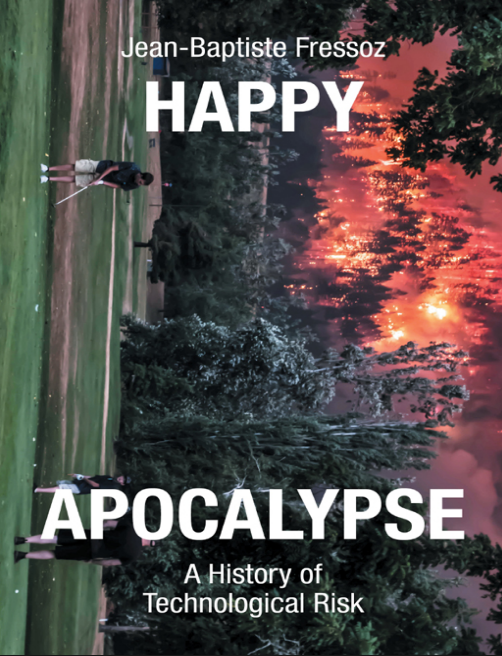
Fressoz, J.-B. (2024). Happy Apocalypse: A History of Technological Risk. Verso Books.
Happy Apocalypse: A History of Technological Risk by Jean-Baptiste Fressoz offers a critical examination of how societies, particularly during the Industrial Revolution, managed and normalized technological risks. Focusing on the 18th and 19th centuries in France and Britain, Fressoz challenges the notion that environmental awareness is a recent development, demonstrating that historical societies actively engaged with the consequences of technological advancements.
Key Themes and Arguments:
Historical Consciousness of Risk:
Contrary to the belief that past societies were oblivious to environmental and technological risks, Fressoz illustrates that they were acutely aware and often apprehensive about the impacts of industrialization. Debates surrounding factories, machinery, vaccines, and railways reveal a deep-seated concern for safety and environmental consequences.
Normalization and Management of Risk:
The book delves into how risks associated with new technologies were not merely accepted but were systematically managed and normalized. For instance, the emergence of the 'polluter-pays' principle in the 19th century, often thought to be a modern concept, was originally established to legitimize the chemical industry's operations by shifting responsibility in a way that favored industrialists.
Role of Expertise and Authority:
Fressoz explores how clinical expertise around 1800 was employed to present vaccinations as entirely safe, effectively silencing public dissent and concerns. This reflects a broader pattern where scientific authority was used to downplay risks and facilitate the adoption of new technologies.
Environmental Disinhibition:
The concept of 'modernizing environmental disinhibition' is introduced to describe the process by which societies became progressively desensitized to environmental degradation. This was not due to ignorance but through deliberate efforts to reframe and manage perceptions of risk, allowing for continued industrial expansion.
Conclusion: Fressoz's work underscores that the challenges of technological risk and environmental management are deeply rooted in historical processes. Understanding these historical dynamics is crucial for informing contemporary debates on technological innovation and environmental policy.
