
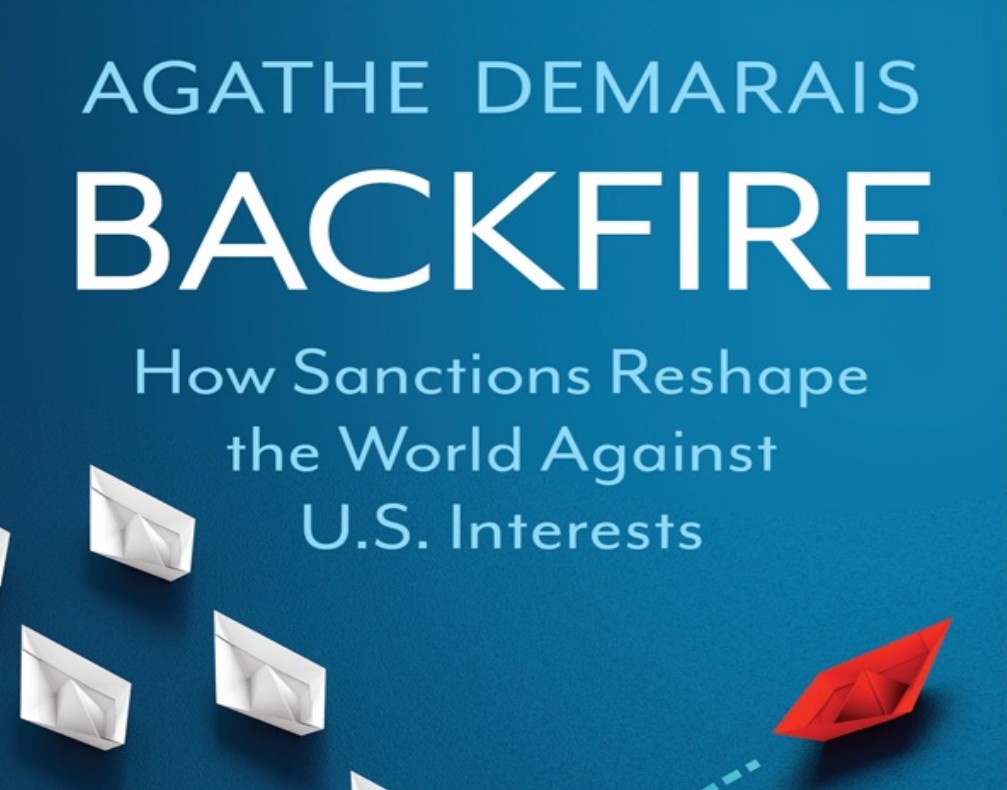
Demarais, A. (2024). Backfire: How sanctions reshape the world against U.S. interests. Columbia University Press.
Backfire in context
Economic sanctions have become Washington’s “Swiss‑army‑knife” response to almost every foreign‑policy challenge. Agathe Demarais, a former French treasury attaché and Economist Intelligence Unit analyst, argues in Backfire that this very ubiquity is eroding U.S. power rather than bolstering it. Drawing on case studies from Cuba to Russia’s 2022 invasion of Ukraine and on more than a hundred insider interviews, she shows how the side‑effects of sanctions—market disruptions, humanitarian damage and accelerated strategic “decoupling” from the dollar system—now routinely outweigh their diplomatic gains.
The book’s core thesis Demarais’ central claim is straightforward: the probability that sanctions will coerce meaningful policy change is low and falling, while their unintended consequences are high and rising. Effectiveness, she maintains, requires four conditions—limited objectives, quick results, a target that is economically fragile, and tight coordination with allies—conditions that the United States rarely meets today.
How sanctions “backfire” Humanitarian and political blowback – Broad embargoes often entrench, rather than weaken, authoritarian regimes by letting them blame external enemies for domestic privation, as seen in Iraq in the 1990s and Venezuela after 2019.
Supply‑chain chaos – The 2018 designation of the Russian aluminium giant Rusal briefly froze a tenth of global supply, spiking prices and forcing a U‑turn in Washington. That episode, and Nord Stream 2 sanctions, illustrate how poorly stress‑tested measures can ricochet onto U.S. allies and firms.
Financial fragmentation – Weaponising dollar‑clearing against Iran and, later, Russia pushes targeted states to build or join alternative networks: China’s CIPS payments system, the digital yuan, rupee‑ruble energy deals and gold‑backed crypto pilots. Every workaround slightly reduces future U.S. leverage.
Corporate over‑compliance (“de‑risking”) – Fear of secondary sanctions leads multinational banks and insurers to exit perfectly legal business with entire regions, hollowing out U.S. commercial presence and ceding market share to less risk‑averse Chinese competitors.
Structure and evidence The narrative proceeds in three parts. Part I traces the evolution of sanctions from Cold‑War trade controls to today’s lists of 15,000 Specially Designated Nationals, highlighting how legal fine print created a vast compliance industry. Part II is a tour of “crossfire” cases—Cuba, Iran’s COVID vaccine procurement, Russia’s sovereign‑debt ban—showing how measures intended for elites hit ordinary citizens or boomerang onto Western supply chains. Part III looks ahead, warning that semiconductor export controls and technology “nodes” may provoke the same backlash in critical‑tech ecosystems that dollar sanctions did in finance.
Policy implications Demarais does not advocate abandoning sanctions altogether; instead she calls for surgical, time‑bound, alliance‑backed measures integrated into a broader diplomatic strategy. The book insists on ex‑ante cost‑benefit analysis (still rare in U.S. practice) and on pairing sanctions with credible off‑ramps to avoid indefinite stalemates. Reviewers in Foreign Affairs and the H‑Diplo roundtable underline her forecast that the “heyday” of U.S. sanctions is ending as rivals learn to inoculate themselves.
Forward‑looking takeaways Multipolar money – As CBDCs, commodity‑linked tokens and regional payment rails mature, future sanctions battles will be fought over “chokepoints” in data and tech standards, not just banking.
Regulatory backlash – Expect more EU and Global South initiatives (e.g., the Anti‑Coercion Instrument) aimed at shielding third‑party firms from extraterritorial fines.
Inside‑out resilience – U.S. competitiveness now depends on domestic investment, not on assuming market dependence will endure.
