
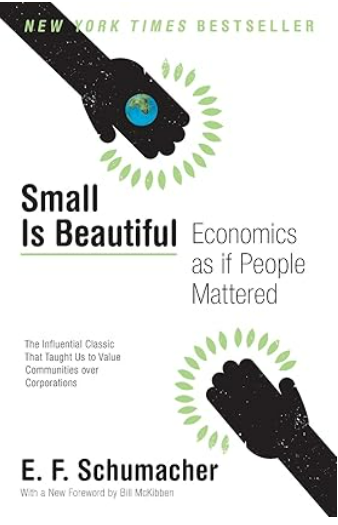
Extended Summary: Small Is Beautiful: Economics as if People Mattered by E.F. Schumacher
E.F. Schumacher's Small Is Beautiful, first published in 1973, presents a compelling critique of conventional economic paradigms, advocating for a human-centric approach that emphasizes sustainability, appropriate technology, and the well-being of individuals and communities. The book is structured into four parts, each addressing different facets of economic thought and practice.
Part I: The Modern World Schumacher begins by challenging the prevailing notion that economic growth and technological advancement are inherently beneficial. He argues that modern economies often treat natural resources as expendable, leading to environmental degradation and unsustainable practices. He introduces the concept of "Buddhist economics," which emphasizes simplicity, non-violence, and the appropriate scale of economic activities, suggesting that well-being should not be measured solely by material wealth but by the quality of life and human fulfillment. Wikipedia
Part II: Resources In this section, Schumacher delves into the mismanagement of natural resources, particularly focusing on the overreliance on fossil fuels and the neglect of renewable energy sources. He critiques the education system for prioritizing technical knowledge over wisdom and moral development, arguing that true education should cultivate individuals who can make thoughtful and ethical decisions. Schumacher also discusses the concept of "appropriate technology," advocating for tools and systems that are sustainable, human-scaled, and tailored to the specific needs of communities.
Part III: The Third World Schumacher addresses the challenges faced by developing countries, criticizing the imposition of Western economic models that often exacerbate poverty and social inequality. He emphasizes the importance of empowering local communities through the development of intermediate technologies that are accessible, affordable, and manageable without extensive external support. By focusing on self-reliance and community-based solutions, Schumacher argues that developing nations can achieve sustainable progress without falling into the traps of industrial overdevelopment.
Part IV: Organization and Ownership In the final section, Schumacher critiques large-scale organizations and centralized systems of ownership, asserting that they often lead to alienation, inefficiency, and a loss of human dignity. He advocates for decentralized structures that prioritize human relationships, community engagement, and democratic participation. By reimagining ownership and organizational models to be more inclusive and responsive to human needs, Schumacher envisions an economy that truly serves people rather than subordinating them to impersonal market forces.
Key Themes and Concepts
Human-Centric Economics: Schumacher emphasizes that economic systems should prioritize human well-being, community cohesion, and environmental sustainability over mere profit and growth.
Appropriate Technology: He introduces the idea of technologies that are tailored to the specific cultural, environmental, and economic contexts of communities, promoting self-sufficiency and reducing dependency on large-scale industrial systems.
Sustainability and "Enoughness": Challenging the notion of limitless growth, Schumacher advocates for a philosophy of "enoughness," where societies aim for a balance between consumption and the planet's ecological limits.
Decentralization and Scale: He argues that smaller, decentralized economic structures are more adaptable, humane, and effective in addressing the nuanced needs of diverse communities.
Legacy and Impact
Small Is Beautiful has had a profound influence on environmental thought, sustainable development, and alternative economic models. It has inspired movements advocating for localism, ecological economics, and human-scale development. The book's emphasis on integrating ethical considerations into economic decision-making continues to resonate in contemporary discussions about sustainability and social justice.
