
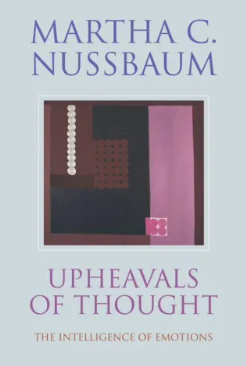
Martha C. Nussbaum’s Upheavals of Thought: The Intelligence of Emotions advances a radical claim: emotions are not irrational eruptions that cloud judgment but cognitively rich appraisals that disclose what we most value. Drawing on the Stoics, Aristotle, and a wide range of literary texts, Nussbaum argues that every emotional “upheaval” expresses a belief about the importance of its object to our flourishing. Fear judges a threat to what we treasure; love affirms the beloved’s irreplaceable worth; compassion connects another’s pain to our own eudaimonia. In exposing these value‑laden judgments, emotions provide an indispensable map of the good life.
The book unfolds in three movements. The theoretical opening reconstructs a genealogy of emotions in classical philosophy and refutes reductionist accounts that see feelings as mere bursts of affect or chemical jolts. Nussbaum shows instead that even the quickest flush of anger presupposes an evaluative storyline—often learned so deeply that its appraisal feels instantaneous. The central section turns to sustained “case studies” of specific emotions. Through close readings of Proust, Dante, and the Mahābhārata, Nussbaum demonstrates how love can widen perception yet lapse into idolatry, how disgust polices boundaries of purity and fuels discrimination, and how compassion, disciplined by imaginative literature, might serve as the civic glue of a plural democracy. Finally, the book moves outward to law and politics, insisting that constitutions, classrooms, and public rituals inevitably traffic in emotion; the only question is whether societies will cultivate emotions that uphold—or corrode—human dignity.
Critics have claimed that Nussbaum over‑intellectualizes feeling, overlooking bodily arousal or the rapid, sub‑cortical circuitry charted by neuroscience. She replies that speed does not negate appraisal: even the startle reflex is filtered through culturally formed judgments of danger. Others fault the book’s initial Western canon bias, though subsequent essays broaden the archive. More fundamentally, Nussbaum’s cognitive‑evaluative model invites productive dialogue with constructionist neuroscientists who view emotions as socially scripted concepts.
The payoff is practical as well as philosophical. If emotions are intelligent, they can—and must—be educated. Literature, narrative medicine, and the arts become laboratories for refining empathy; welfare systems can be redesigned to avoid the shaming scripts that sap agency; political discourse can transform raw anger into “transition‑anger” oriented toward repair rather than revenge. In an age of algorithmic governance, Nussbaum’s thesis also issues a warning: tech platforms that treat emotion as a manipulable commodity risk weaponizing fear and resentment, undermining the very foundations of democracy.
Upheavals of Thought thus reframes the emotional life as a site of both vulnerability and ethical insight. To understand our feelings is to read the story of what we hold dear—and to glimpse the contours of a more compassionate, resilient society.
